

 May 7, 2026
  3 mins to read
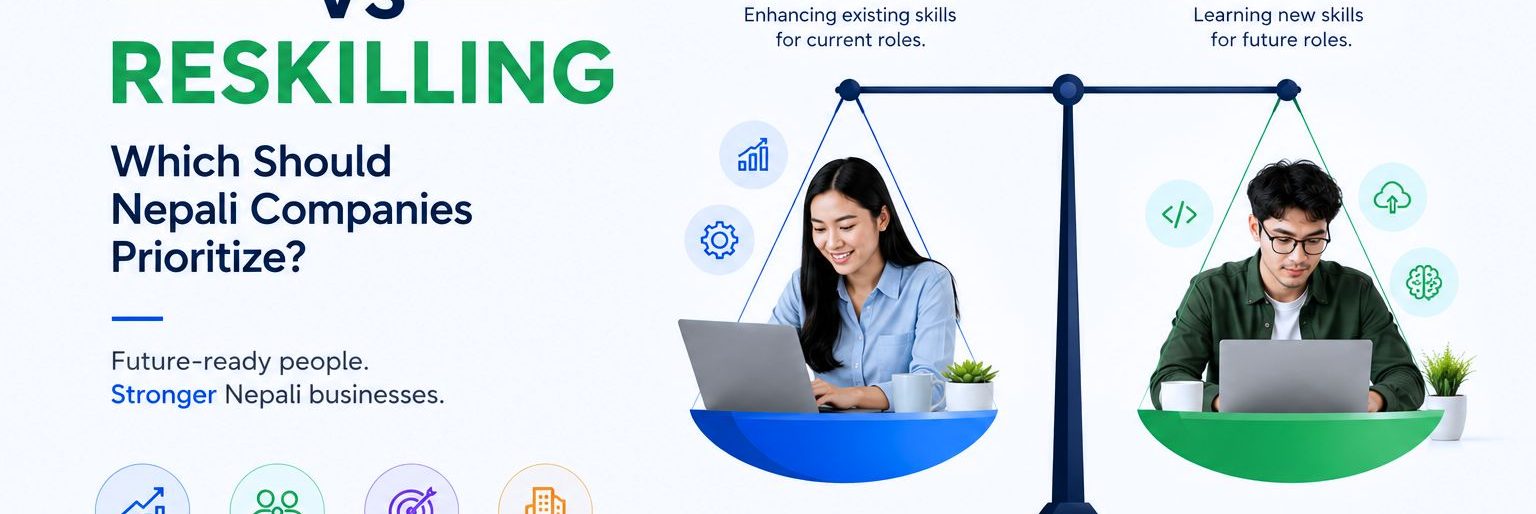
 In Nepal’s rapidly evolving job market, companies are struggling with one major challenge: skills gap. While businesses are expanding, technology is advancing, and customer expectations are rising, the workforce often doesn’t have the right skills to keep up. This is where upskilling and reskilling become essential.
But the question is which should Nepali companies prioritize?
Let’s break it down.
What is Upskilling?
Upskilling means helping employees learn new skills that make them better at their current jobs.
Examples in Nepal:
- A graphic designer learning motion graphics.
- A recruiter learning AI-based hiring tools.
- A salesperson improving data analytics skills.
Why Upskilling Matters:
- Boosts productivity
- Enhances performance
- Improves employee satisfaction
- Reduces small skill gaps within existing roles
- What is Reskilling?
Reskilling means training employees to take on an entirely different role usually because the company’s needs are changing.
Examples in Nepal:
- A finance assistant transitioning into HR.
- A field marketer learning to become a digital marketer.
- A data entry staff learning Python and moving into data analysis.
Why Reskilling Matters:
- Helps companies fill critical talent shortages
- Reduces hiring costs
- Enables internal mobility
- Future-proofs the workforce
- The Nepali Corporate Reality: What’s Happening in 2025?
1️⃣ Tech Adoption is Rising
FinTech, EdTech, eCommerce, HRTech, and digital service companies are scaling quickly. But skilled workers are limited.
2️⃣ Traditional Roles Are Transforming
- HR → HR Analytics
- Marketing → Digital-first Marketing
- Admin → Tech-enabled Operations
3️⃣ Talent Shortage is a Major Problem
Companies complain: “Candidates are available, but skills are not.”
So, Which Should Nepali Companies Prioritize?
1. For Immediate Business Growth → Upskilling
If the company wants quick improvement, upskilling works best.
Perfect for:
- Customer support teams
- Sales teams
- HR recruiters
- Graphic designers
- Digital marketers
Why?
Because small skill improvements create big output improvements.
2. For Long-Term Sustainability → Reskilling
If the company wants to future proof the workforce, reskilling is essential.
Perfect for:
- Roles becoming outdated
- Businesses wanting to go digital
- Companies facing critical skill shortages
- Employees showing high potential but stuck in old roles
The Ideal Strategy for Nepali Companies
Nepal doesn’t need to choose one; it needs a balance of both.
Recommended Approach:
70% Upskilling
For improving existing performance and keeping teams competitive.
30% Reskilling
For preparing employees for future roles and reducing hiring costs.
How Reach HR Solutions Can Support This Transition
At Reach HR Solutions, companies can benefit from:
Training Programs
Leadership, communication, sales, customer service, HR, and management.
Courses
- Graphics and UI/UX design
- Data science and AI
Recruitment & Workforce Planning
We help companies identify skill gaps and create strategies to upskill or reskill teams effectively.
Final Thought
In today’s competitive world, the companies that invest in employee development will lead the market. Nepali businesses should focus on upskilling for immediate performance and reskilling for long term growth.A skilled workforce isn’t just an asset, it’s a competitive advantage.
Leave a Comment