

 June 11, 2026
  5 mins to read
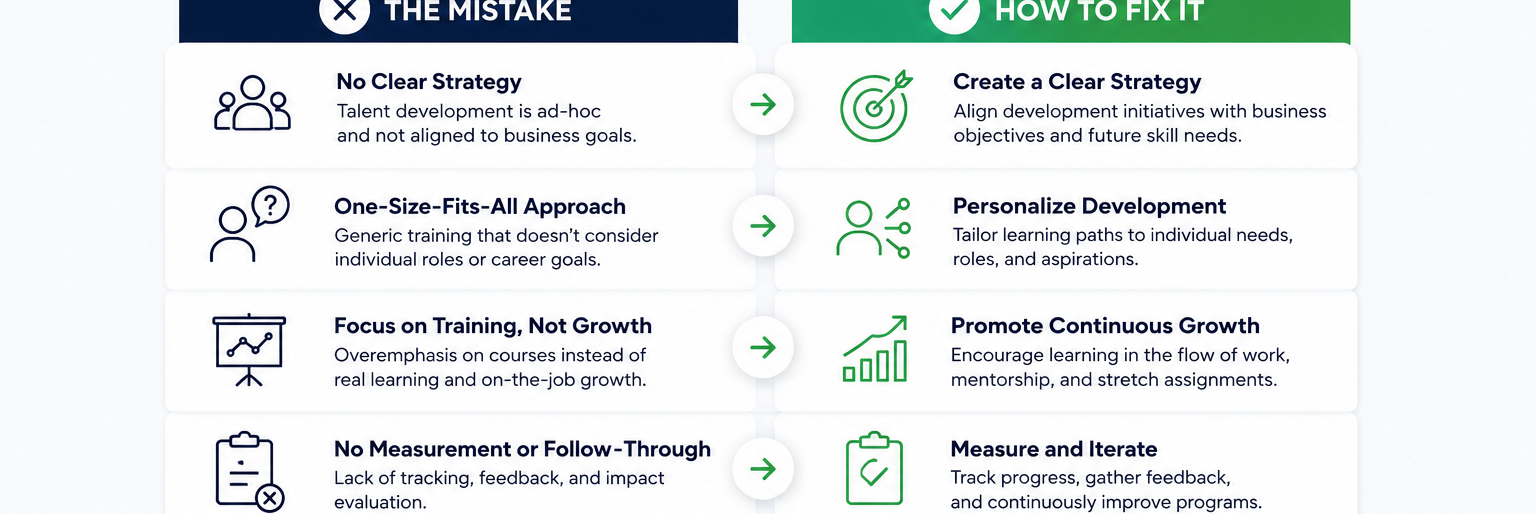
 Talent development is no longer a “nice to have” , it’s a business necessity. Organizations that invest in their people outperform competitors in productivity, retention, and innovation. Yet, many companies still struggle to get real results from their talent development efforts.
Why?
Because they unknowingly make common mistakes that limit the impact of even the best intentioned programs.
Let’s explore the most frequent talent development mistakes and, more importantly, how to fix them.
1. Mistake: Treating training as a one time event
Many companies view talent development as a once a year workshop or a mandatory online course. Employees attend, tick the box, and return to work often with little long term impact.
Why it’s a problem:
Learning fades quickly without reinforcement. One off training rarely changes behavior or improves performance.
How to fix it:
- Create continuous learning programs instead of isolated sessions
- Use microlearning (short, focused lessons)
- Schedule follow up sessions and practice opportunities
- Reinforce learning through coaching and feedback
2. Mistake: Not aligning development with business goals
Some organizations invest in trendy courses or generic training topics without linking them to business needs.
Why it’s a problem:
Employees may gain skills that don’t directly support company strategy, leading to wasted time and resources.
How to fix it:
- Identify your key business priorities
- Conduct skill gap assessments
- Design training programs that support strategic objectives
- Regularly review and adjust development plans
3. Mistake: Ignoring individual career aspirations
A one size fits all development approach overlooks individual goals, strengths, and motivations.
Why it’s a problem:
Employees feel undervalued and disengaged when their personal growth needs aren’t considered.
How to fix it:
- Introduce Individual Development Plans (IDPs)
- Hold regular career conversations
- Offer multiple learning paths
- Match development opportunities with employee interests
4. Mistake: Focusing only on high performers
Many companies invest heavily in top performers while neglecting the rest of the workforce.
Why it’s a problem:
This creates resentment, limits overall team growth, and ignores hidden potential in average performers.
How to fix it:
- Offer development opportunities for all employees
- Use data to identify high-potential employees (HiPos)
- Create tiered learning programs
- Encourage peer learning and knowledge sharing
5. Mistake: Poor manager involvement
Talent development is often treated as HR’s responsibility alone, with minimal manager participation.
Why it’s a problem:
Managers play a critical role in coaching, feedback, and daily skill reinforcement. Without them, development efforts fall flat.
How to fix it:
- Train managers on coaching and mentoring
- Make development a KPI for leaders
- Encourage regular check ins
- Equip managers with development tools and resources
6. Mistake: Failing to measure impact
Some organizations invest in training without tracking results or ROI.
Why it’s a problem:
Without data, it’s impossible to know what’s working, what isn’t, and where to improve.
How to fix it:
- Define clear learning objectives
- Track performance improvements
- Use employee feedback surveys
- Measure retention, productivity, and engagement metrics
7. Mistake: Overlooking soft skills
Many companies focus only on technical skills and neglect leadership, communication, and emotional intelligence.
Why it’s a problem:
Soft skills directly impact teamwork, leadership effectiveness, and company culture.
How to fix it:
- Include soft skills in development programs
- Offer leadership and communication training
- Use coaching and mentoring programs
- Promote collaborative learning experiences
8. Mistake: Not creating a learning culture
Some companies run training programs but fail to embed learning into everyday work life.
Why it’s a problem:
Employees won’t prioritize development if it’s not supported or rewarded by leadership.
How to fix it:
- Encourage continuous learning behaviors
- Recognize and reward development efforts
- Lead by example at the leadership level
- Provide easy access to learning resources
9. Mistake: Relying too heavily on external training
While external courses can be valuable, over dependence on them can disconnect learning from real business challenges.
Why it’s a problem:
Employees struggle to apply generic training to company-specific needs.
How to fix it:
- Combine external training with in house programs
- Use real business projects as learning tools
- Encourage internal mentoring
- Customize training content to your organization
10. Mistake: Neglecting succession planning
Many organizations develop employees without preparing them for future leadership roles.
Why it’s a problem:
Leadership gaps arise when senior leaders leave unexpectedly.
How to fix it:
- Identify future leadership roles early
- Develop high potential employees
- Create leadership pipelines
- Integrate succession planning into talent development
How Reach HR Solutions Can Help
At Reach HR Solutions, we help organizations design and implement practical, results driven talent development strategies.
Our services include:
- Skill gap analysis and workforce assessments
- Individual Development Plan (IDP) frameworks
- Leadership and soft skills training
- Manager coaching programs
- Succession planning solutions
Final Thoughts
Talent development isn’t just about training, it’s about creating a structured, strategic, and people centered growth system.
By avoiding these common mistakes and implementing thoughtful solutions, organizations can unlock the full potential of their workforce, boost engagement, and build a strong leadership pipeline for the future.
If your talent development efforts aren’t delivering the results you expected, we’re here to help.
Leave a Comment